
What does it mean for cooperatives to be “built for this moment”?
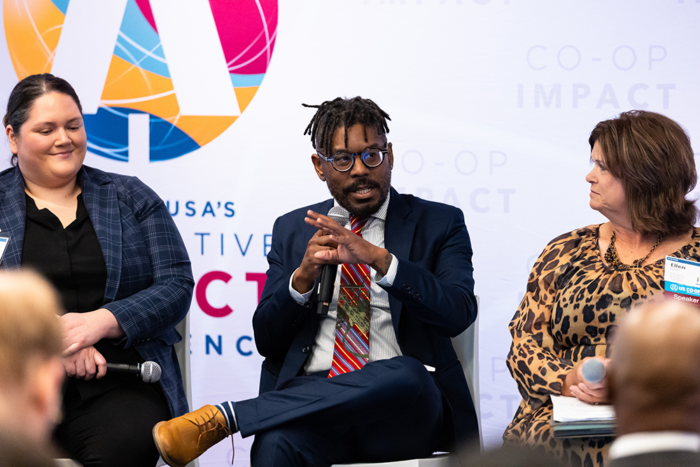
That question brought together cooperative leaders, developers, advocates, financers and innovators in Washington, DC this month for the 10th Annual Cooperative IMPACT Conference hosted by newly renamed U.S. Co-ops.
During his opening remarks, U.S. Co-ops’ President and CEO Doug O’Brien set the stage. “Too many people struggle to find genuine economic opportunity,” he said. “Families and communities are wrestling with affordability. Democratic institutions are strained. And technology is advancing at breakneck speed—with enormous potential, but also with the risk that people get marginalized rather than empowered.”
These generational challenges make cooperatives more relevant than ever, O’Brien said. “[Co-ops] give people a way to participate in their economy. A way to own their future. And a way to confront problems together that are very difficult to solve alone.”
Over two days of sessions, Lightning Talks and discussion groups, a central message emerged: cooperatives aren’t simply built to withstand moments of change. They’re built to recognize and seize the opportunities change brings. In fact, some of the most powerful cooperative solutions emerge in moments of crisis.
Finding opportunity in disruption
That message came to life during Thursday’s keynote from Shawna Nelson, CEO of CROPP Cooperative | Organic Valley, the largest organic farmer-owned cooperative in the country.
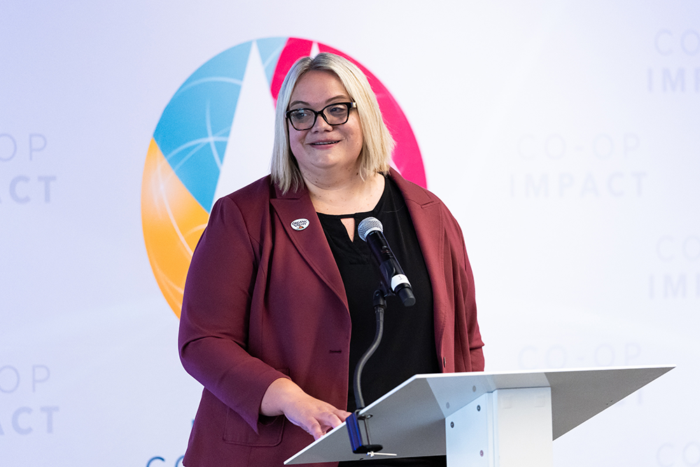
In the 1980s, family farmers were disappearing under the weight of low prices, high interest rates and consolidation. Farmers were told to get big or get out. But in 1988, seven farmers in Wisconsin had a better idea: they formed a cooperative that made it possible for small dairy farmers to survive. Today, that co-op is the largest organic, farmer-owned cooperative in the country.
While Organic Valley has grown to more than 1,500 farmer-members, cooperative ownership continues to drive business decisions. Nelson described how, in 2022, Organic Valley stepped in to help dairy farmers who were losing their milk markets. In one particularly urgent case, 14 Pennsylvania farmers learned that their buyer would stop collecting their milk just days before the cut-off. Nelson traveled to meet with the farmers, and together, they worked to find a new market. Less than two weeks later, “their milk had a home again, and they were part of a cooperative,” she said.
“We’re creating value in a way nobody else is,” Nelson added, referring to the democratic decision-making process at cooperatives.
In another example, Nelson explained how Organic Valley’s farmer-elected board sets the price members will receive for their milk before management develops the annual operating budget. “We pay the farmers first, and then run the business,” she said.
Her challenge to cooperative leaders was to lean into what makes their business model distinct. “Run your co-op like a co-op. People want what we already have,” Nelson said. “It’s rare, and it’s powerful.”
Recognizing co-op champions
Day 2 programming kicked off with recognition of two federal policymakers for their support of cooperative businesses. U.S. Co-ops presented its 2026 Co-op IMPACT Champion Awards to Senators Deb Fischer of Nebraska and Ed Markey of Massachusetts.
Sen. Fischer was recognized for her leadership in introducing the bipartisan Strengthening Rural Cooperatives and Communities Act, which would reauthorize and strengthen USDA’s Rural Cooperative Development Grant program—an important source of support for cooperative development in rural communities. Sen. Markey was recognized for his work supporting small businesses, including his role as Ranking Member of the Senate Committee on Small Business and Entrepreneurship.
Both senators are in their home districts this month and will accept their awards when they are back in Washington, DC.
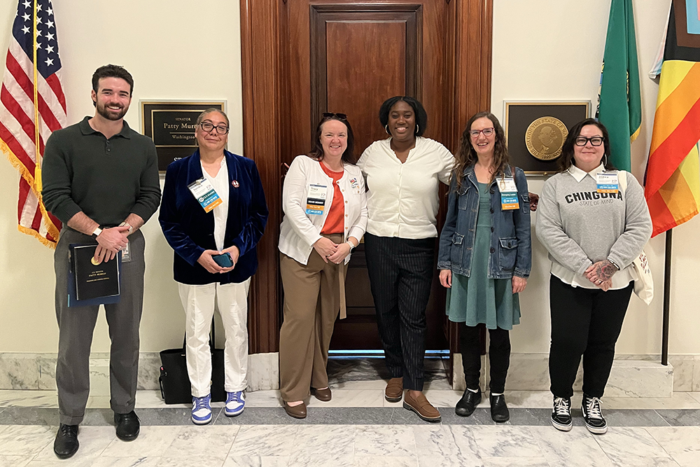
Building on this advocacy focus, Day 2’s morning plenary session, “Beyond the Policy Win: Building a Stronger Cooperative Ecosystem,” explored what effective cooperative advocacy looks like. The afternoon before, 60 IMPACT 2026 attendees had the opportunity to practice their advocacy skills during U.S. Co-ops’ 4th annual Hike the Hill.
Telling the cooperative story
We closed Day 2 with the IMPACT 2026 Film Fest. Now in its second year, our film fest was generously sponsored by National Co+op Grocers and the Principle 6 Cooperative with in-kind support from Art.coop, Digital Development Communications and Meerkat Media. This year’s film fest celebrated the best in co-op storytelling—from social media reels to mini-documentaries.
Out of 49 videos submitted this summer across three categories, the co-ops below were recognized for showcasing how video can capture the heart of cooperation, bring co-op stories to life and connect with audiences in ways that words alone sometimes can’t. Each winning co-op received a $2,000 prize thanks to support from Principle 6 Cooperative.
- Best Social Media Video: Hanover Co-op Food Stores in Hanover, NH for “Who Are They, What Are They, Where Are They?”
- Best Short Form Video: BriarPatch Food Co-op in Grass Valley and Auburn, CA for “BriarPatch Vignettes”
- Best Long Form Video: Seafood Producers Cooperative in Sitka, Alaska for “The Fishermen’s Co-op Since 1944”
Watch all the submissions on our YouTube channel
Built for what’s next
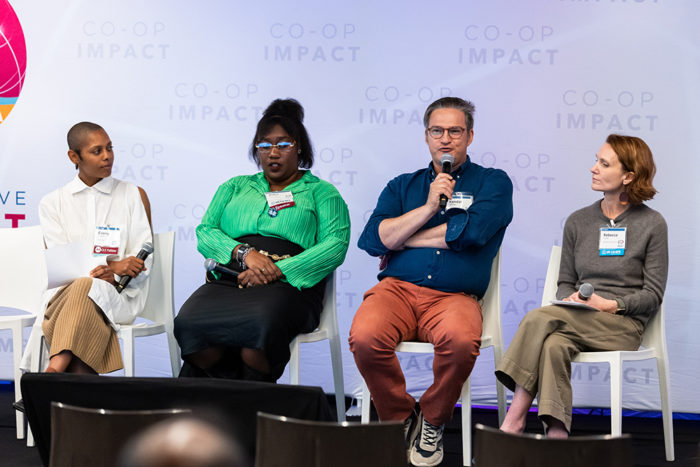
As U.S. Co-ops celebrates its 110th anniversary and the Cooperative IMPACT Conference marks a decade of bringing the movement together, this year’s gathering offered an opportunity to reflect on how far cooperatives have come—and where they can go next.
From the founding of Organic Valley to emerging models of cooperative finance, cross-sector partnerships and new approaches to advocacy, IMPACT 2026 highlighted the creativity and collective action that have defined the cooperative movement for generations.
The challenges facing communities and businesses continue to evolve. So do the opportunities for cooperatives to lead and innovate. Cooperatives are not only built for this moment; they’re built for what’s next.